
Feels of Green Dispensary • Cannabis education • 2026
Indica, sativa or hybrid? Start with what the labels mean—then see what the science actually supports.
A clear comparison, two major scientific studies, practical product-label examples and a simple label-reading tool for adults who want better information than a strain stereotype.
The quick answer
Indica, sativa and hybrid are familiar cannabis categories, not scientifically dependable predictions of effects. Indica is traditionally described as calming, sativa as stimulating and hybrid as a mix. But a systematic review published October 24, 2026 found no reliable rule linking these labels to a product's chemistry or how someone will respond. Measured product information, format, amount used and personal factors provide more meaningful context. [1]
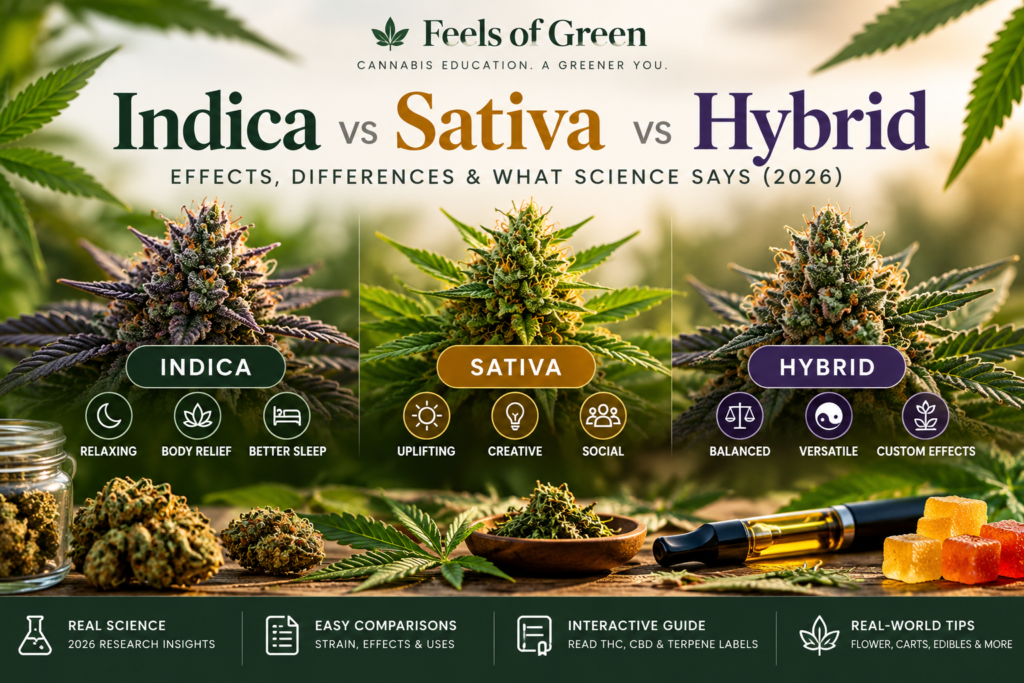
A common retail label historically associated with calming experiences—not proof of a sedating effect.
A common label historically associated with more energetic experiences—not proof of stimulation.
A label often used for mixed ancestry or characteristics—not a guarantee of balance or strength.
These are conventional descriptions, not medically established outcomes or personalized recommendations.
Indica vs sativa vs hybrid: side-by-side comparison
The key distinction is between what a product is called and what is actually measured. This chart makes that distinction explicit.
| Category | Traditional description | What it may convey | What it does not prove |
|---|---|---|---|
| Indica | Relaxing, evening-oriented | A retail classification or ancestry convention | That the product causes sleepiness, eases anxiety or has a particular THC percentage |
| Sativa | Uplifting, daytime-oriented | A retail classification or ancestry convention | That the product creates energy, focus or a consistent mental effect |
| Hybrid | Mixture of indica and sativa traits | Mixed lineage or a broad marketing category | That effects will be “balanced,” milder or predictable |
Indica
- Traditionally described as
- Relaxing or evening-oriented
- May convey
- A commercial classification or ancestry convention
- Does not prove
- Sedation, anxiety relief or any particular THC percentage
Sativa
- Traditionally described as
- Stimulating or daytime-oriented
- May convey
- A commercial classification or ancestry convention
- Does not prove
- Energy, focus or a predictable mental effect
Hybrid
- Traditionally described as
- A blend of characteristics
- May convey
- Mixed ancestry or a broad retail category
- Does not prove
- Balanced, milder or predictable effects
On narrower tablets, swipe sideways to see the complete table. On phones, it becomes separate readable cards.
More useful than the category: check the tested cannabinoid amounts, whether values refer to a serving or whole package, product type, producer and available batch information. Even a detailed label cannot guarantee an individual's experience. [3]
What do indica, sativa and hybrid actually mean?
Indica: a traditional classification, not a sleep guarantee
In modern dispensary language, “indica” often signals a product marketed for a more calming experience. That message is familiar, but it is not a chemical test result. Two flower products both labeled indica can differ in THC, CBD, minor cannabinoids, terpene measurements and other characteristics.
It is therefore misleading to infer that every indica product causes sleepiness or provides relief from a health condition. The label can help a shopper navigate a menu, but it should not substitute for looking at the product itself.
Sativa: a retail description, not a reliable energy prediction
“Sativa” is often used as shorthand for daytime, uplifting or cerebral experiences. Those expectations are common in cannabis culture, but they do not establish what an individual product will do. The 2026 systematic review found inconsistent links between marketing labels and reported outcomes. [1]
People also respond differently depending on factors such as THC concentration, previous experience, other substances and product format. A sativa label does not eliminate the risk of impairment.
Hybrid: broader than a 50/50 mixture
Hybrid generally describes products with mixed ancestry or characteristics. A hybrid designation does not require a precise 50/50 genetic balance, an intermediate THC percentage or equal relaxing and energizing effects. Terms such as “indica-dominant” and “sativa-dominant” are also used in retail marketing and should not be interpreted as validated predictors of how a product will feel.
The distinction that matters
Plant ancestry, chemistry and human response are different questions. The label may communicate how a product is categorized for sale. A laboratory report describes measured compounds in a particular sample or batch. Neither one can forecast an individual's outcome with certainty.
What the October 2026 scientific review found
On October 24, 2026, researchers published a systematic review in the Journal of Cannabis Research examining whether consumer-facing indica, sativa and hybrid labels reliably predict composition or effects. The review included 28 peer-reviewed reports, representing different kinds of evidence—not 28 randomized clinical trials. [1]
12 analyzed plant or product composition; 1 examined marketed preparations in animals; 15 considered human outcomes.
These are study categories, not evidence votes.
Results across the different evidence types did not demonstrate a dependable correspondence between product labels and measurable chemistry or outcomes. Some individual studies found associations for selected outcomes, but these were inconsistent, and not every analysis adjusted for THC concentration and other important differences.
The authors specifically cautioned against predicting therapeutic responses from the retail classification or assuming terpene profiles are sufficient to establish effects. Their accepted, peer-reviewed paper is an early online version, which may receive further edits before the final version of record. [1]
What the review supports
A simple indica-versus-sativa-versus-hybrid label is not a reliable stand-alone guide to composition or outcome.
What it does not establish
It does not mean every product is identical, that all experiences are the same, or that a terpene panel can reliably predict individual results.
What the 89,923-sample cannabis study actually measured
A 2022 study in PLOS ONE analyzed commercial cannabis flower samples submitted for testing by cultivators in six US states. Its final cleaned dataset included 89,923 samples with cannabinoid measurements, but only 42,843 with usable terpene measurements. The researchers found that commonly used indica, hybrid and sativa labels did not neatly map onto the chemical categories revealed by the data. [2]
42,843 of the same samples had usable terpene measurements (47.6%). These were commercial flower samples from testing labs in six US states.
That distinction matters: an article saying that all 89,923 samples had complete terpene tests would overstate the data. The research also does not establish how a specific flower in a current dispensary inventory will affect a particular person. It describes a large, nonrandom commercial testing dataset and the limitations of broad classification labels.
What matters beyond an indica, sativa or hybrid label?
- THC content and how the amount is expressed. THC is the principal intoxicating cannabinoid. A percentage on dried flower is not interchangeable with milligrams per serving in an edible. More THC can mean greater impairment and risk, but a percentage is not a personal effect forecast. [3]
- CBD and other reported cannabinoids. A laboratory label may report CBD alongside THC. CBD is not simply a safety guarantee, and the presence or absence of CBD does not make the indica/sativa classification reliable.
- Terpene profile. Terpenes are aromatic compounds associated with a product's smell and flavor. Their presence can be measured where testing is available; claims that an individual terpene reliably produces a particular mental or medical effect go beyond current human evidence. [1]
- Product form and route. Flower, vaporized concentrates and edibles differ in formulation, onset and potential risks. An indica-marketed edible should not be treated as equivalent to an indica-marketed flower.
- Personal and situational factors. Prior experience, other substances, underlying health factors and individual biology influence effects. Do not drive or use hazardous equipment while impaired. [3]
A note about percentages, milligrams and THCA
Flower and vape labels commonly use percentages, while edibles often list milligrams of THC per serving and per package. Labels can also separately describe THCA and calculated total THC. Do not compare these formats as though they are identical, or infer the same impairment from equal-looking numbers. For an accurate comparison, identify the unit, product form and what the tested figure covers.
Indica vs sativa vs hybrid in flower, vape carts and edibles
Flower and pre-rolls
With flower, the three categories tend to function as menu filters and conventional strain descriptions. A better starting point is the product's cannabinoid testing, batch information and the source of any claims about characteristics. Two flowers bearing the same label may have notably different lab measurements.
Vape cartridges and disposable devices
A cartridge's formula matters in addition to its retail strain name. Check whether the listing identifies distillate, live resin or another preparation; the actual ingredients; tested potency; and compatible hardware or device information where relevant. The indica/sativa/hybrid label alone cannot tell a reader what is in the oil or predict health outcomes. Vaping products also carry inhalation-related risks. [3]
Gummies and other edibles
For an edible, the distinction between milligrams per serving and milligrams per package is especially important. Edible effects may take 30 minutes to two hours to become noticeable, and effects can be longer-lasting and less predictable than with inhaled products. A “sativa gummy” does not remove those risks. [4]
For relevant product-category information, Feels of Green provides pages for flower, cartridges and edible gummies. Availability and label details should always be checked on the current listing.
How to read a real cannabis product label
Rather than asking only, “Is this indica or sativa?” try asking, “What information is actually printed, what has been tested and what remains uncertain?” The example below shows where to look. It intentionally includes no fabricated brand, potency, batch or inventory values.
1. Verify product form (flower, vape or edible).
2. Identify the marketing classification, if shown.
3. Read THC/CBD numbers and their correct units.
4. Check batch and available test references.
No real product values are shown.
Interactive cannabis label reader: understand the numbers
This educational tool translates basic packaging fields into plain language. It does not recommend a dose, assign a safety rating or predict a high. All fields other than product form are optional, so you can learn without having a full laboratory report.
Read a label in three steps
Choose the product form, enter optional label numbers, and receive a description of what those numbers mean—and what they do not establish.
What does this tool intentionally leave out?
It does not interpret personal medical conditions, estimate intoxication, convert flower potency into an edible dose, or make product suggestions. A batch lab result describes a tested sample and does not independently prove how any person will respond.
If you do not know the numbers on a package, select only the product form and click “Explain my label” for a short checklist. Entered information stays in this browser session; the tool does not send the values to Feels of Green.
Five useful questions to ask while comparing cannabis products
- What product type am I looking at? Flower, concentrate and edible packaging use different measurements and have different risk considerations.
- Is the claimed indica/sativa/hybrid classification the only product description? If so, important information is still missing.
- Does the label identify measured THC and CBD with their correct units? Percentages and milligrams are not interchangeable.
- Can I find producer, batch and tested-product information? Use current manufacturer and dispensary records when available.
- Does a benefit claim go beyond the evidence? A traditional strain stereotype is not evidence of pain relief, anxiety treatment, better sleep or reduced risk.
These questions are useful even without buying anything. They keep product descriptions grounded in what can be checked rather than creating expectations a label cannot support.
Indica vs sativa vs hybrid: questions people also ask
Which is stronger: indica, sativa or hybrid?
No category is automatically stronger. Measured THC, product form and the amount used matter more than the retail label for understanding possible intoxication and risk. A label alone does not forecast an individual's experience.
Does indica always make you sleepy?
No. “Relaxing” is a traditional association, not an effect guarantee. Studies reviewed in 2026 did not support reliable predictions based only on indica, sativa or hybrid labels. [1]
Does sativa always give you energy?
No. Sativa is often marketed as uplifting, but the classification cannot reliably establish energy, focus or alertness. Cannabis can impair coordination and judgment regardless of how a product is marketed.
Is hybrid always half indica and half sativa?
No. A hybrid category often refers broadly to mixed lineage or characteristics. It does not establish a fixed genetic fraction or a predictable balance of effects.
Are indica, sativa and hybrid scientifically meaningless?
They have botanical and historical uses, and they remain common retail descriptors. What the evidence challenges is their reliability as stand-alone predictors of commercial cannabis chemistry or a person's effects—not whether plant genetic differences exist.
Do terpenes determine whether a strain feels relaxing or energizing?
Terpenes influence aroma and can be measured in many products, but the current human evidence is insufficient to establish a reliable terpene-to-effect rule or a medical recommendation based on terpene content. [1]
Is a hybrid gummy different from a hybrid vape?
Yes, the formats differ in ingredients, routes of administration, onset and risks. The shared word “hybrid” does not make the products equivalent. Edibles may take 30 minutes to two hours before effects are felt. [4]
Is a higher THC percentage always better?
No. Higher THC can increase the likelihood of impairment and adverse effects, and it does not guarantee a better experience. Numbers must also be interpreted in the context of product type, units and personal factors. [3]
What is the difference between THC percent and THC milligrams?
A percentage describes concentration by a specified measure; milligrams describe an amount. For an edible, confirm whether the milligrams refer to a single serving or the entire package. Do not directly equate edible milligrams with flower percentages.
Can I use these labels to choose cannabis for anxiety, pain or sleep?
How this guide relates to Feels of Green in Newton, New Jersey
Feels of Green is a cannabis dispensary in Newton, Sussex County, New Jersey. Its website includes an online menu and separate educational product pages for cannabis flower, cannabis cartridges and edibles. Use the menu to check actual availability and the details supplied for each product; we have not independently verified any particular product batch for this guide.
New Jersey adult-use cannabis sales are restricted to people 21 or older with required age verification. Visitors should follow New Jersey law and applicable dispensary procedures. Cannabis must not be transported across state lines, including into neighboring Pennsylvania. Online browsing is not a promise of interstate shipment. [5]
Browse the Feels of Green menu
Use the label-reading checklist as you review product descriptions and any available testing information. Menu categories are useful for navigation; measured details deserve their own attention.
Research approach, limitations and sources
How this guide was prepared
This is a literature-informed, general consumer-education guide compiled using a peer-reviewed 2026 systematic review, a 2022 chemical-composition study, public-health information and the New Jersey Cannabis Regulatory Commission's consumer guidance. Sources were checked on October 27, 2026. We distinguish traditional marketing descriptions from measured evidence.
What this guide does not contain: original clinical trials, independently verified Feels of Green product-batch tests, a survey of customers or a medically qualified review. The product label and figures above are educational original illustrations, not representations of available store inventory. No real staff author, clinical reviewer or credential is claimed within this code; WordPress should display the actual author when confirmed.
Primary research and official references
- Zoobi G, Marco M, Foraida KJ, Tandon S, Zhornitsky S. Do consumer-facing “Indica,” “Sativa,” and “Hybrid” labels predict cannabis composition or effects? A systematic review. Journal of Cannabis Research. Published October 24, 2026. Early peer-reviewed online version, subject to further editing. Read the research (DOI).
- Smith CJ et al. The phytochemical diversity of commercial Cannabis in the United States. PLOS ONE. 2022. Study of 89,923 cleaned commercial flower samples, including 42,843 with usable terpene measurements. Read the original study.
- US Centers for Disease Control and Prevention. About Cannabis. Information on cannabinoids, product formats and factors affecting responses. CDC cannabis overview.
- US Centers for Disease Control and Prevention. Cannabis and Poisoning. Guidance on edibles, delayed onset and unpredictable effects. CDC edible-cannabis guidance.
- New Jersey Cannabis Regulatory Commission. Recreational Cannabis in New Jersey. Consumer purchasing and interstate transport restrictions. Official NJ guidance.