
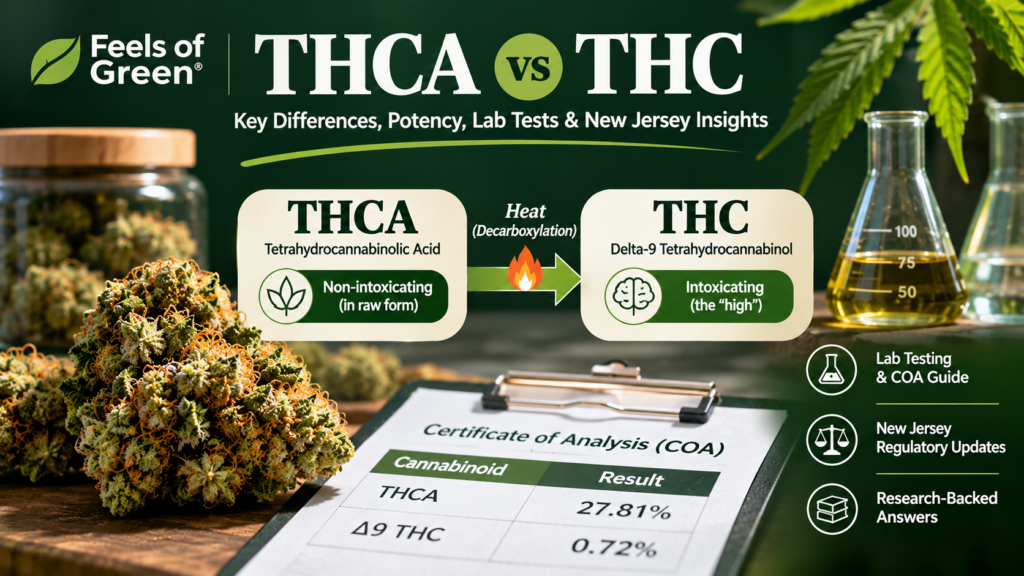
THCA is the natural acidic precursor of delta-9 THC, the main intoxicating compound in cannabis. In its unchanged form, THCA generally does not cause the same intoxication as THC. They have different chemical structures, and THCA can change into THC by decarboxylation. A laboratory can report both separately; total THC is a calculated label value, not a prediction of effects. [1] [13]
Why does a cannabis flower label sometimes show more than one THC-related number? At Feels of Green, we want to make those numbers easier to understand. This guide starts with the chemistry, then shows what independent testing and New Jersey’s own audit reveal about the reliability of the measurements.
THCA
Acidic cannabinoid precursor. Common in unprocessed cannabis flower. Generally does not produce the characteristic intoxication associated with delta-9 THC itself.
Delta-9 THC
Neutral cannabinoid. Associated with intoxication and impairment. Its measured concentration is different from an estimate of personal exposure.
THCA vs THC: the main differences
| Characteristic | THCA | Delta-9 THC |
|---|---|---|
| Chemical form | Acidic precursor | Neutral cannabinoid |
| Intoxication | Not typically intoxicating in its unchanged form | Intoxicating; may impair attention and coordination |
| Laboratory entry | Separately measured concentration | Separately measured concentration |
| Stability | Can undergo chemical conversion | Can change or degrade over time |
| Research | Much evidence remains preclinical | More extensive human research; risks remain |
On a package, “THC” can mean delta-9 THC or a calculated total. Check the full label name and unit before comparing values. A large percentage does not, on its own, tell you how a person will feel or whether a product is free of contaminants.
What is THCA in cannabis?
THCA stands for tetrahydrocannabinolic acid. Cannabis produces acidic cannabinoids in glandular trichomes, the small structures found on the plant. The plant enzyme THCA synthase converts a precursor called cannabigerolic acid (CBGA) into THCA. That is why THCA can be a prominent part of the chemical profile of cannabis flower. [13]
The word “acid” identifies a chemical feature, not how the product tastes or how harmful it is. THCA and THC are often present together, so the presence of THCA does not mean that a sample contains no delta-9 THC.
What is delta-9 THC?
Delta-9-tetrahydrocannabinol (delta-9 THC) interacts with the body’s endocannabinoid system, including CB1 receptors involved in brain signaling. This helps explain its intoxicating effects. It can affect memory, attention, perception and coordination. THCA has different receptor activity; it should not be treated as a pharmacological equivalent. [14] [2]
Individual responses vary. Cannabinoid concentrations cannot account for every factor, including individual sensitivity, other substances and health history. The CDC identifies cannabis-related impairment and dependence as important public-health concerns. [2]
How are THCA and THC chemically related?
THCA contains a carboxyl group that delta-9 THC lacks. During decarboxylation, the molecule loses carbon dioxide. This chemical change can occur with heat and over time. It is why the two molecular formulas below differ, and why sample history matters to laboratory interpretation. A real sample need not undergo complete conversion. [1] [13]
Acidic precursor
C₂₂H₃₀O₄
Neutral cannabinoid
C₂₁H₃₀O₂
It is also useful to distinguish chemistry from common product names. A name such as live resin, rosin or flower tells us something about the product format or processing, not its entire chemical composition. Our live resin versus live rosin guide explains how extraction terminology differs from cannabinoid measurements.
THCA vs total THC: what the numbers on a label mean
THCA and delta-9 THC are concentrations a laboratory can measure separately. Total THC is a calculated reporting value that accounts for both forms. New Jersey’s labeling rule specifies a molecular-mass adjustment for THCA because carbon dioxide is lost during decarboxylation. The calculation describes composition under a reporting convention, not how much THC reaches a person’s bloodstream. [3]
Three fields, three meanings
| Field | Meaning | What it does not show |
|---|---|---|
| THCA | Reported acidic cannabinoid level | Individual intoxication |
| Delta-9 THC | Reported neutral cannabinoid level | Amount absorbed by a person |
| Total THC | Derived reporting value accounting for THCA and delta-9 THC | Actual delivered THC, impairment or safety |
A percentage is a proportion; a milligram is a unit of mass. Check whether the column refers to dry weight, the material as tested, an entire package or another stated basis. Two printed numbers are not comparable just because they have the same digits. If the basis is unclear, the report needs clarification.
Another label may list total cannabinoids, sometimes abbreviated TAC. This is a broader aggregate rather than a synonym for total THC. The cannabinoids included and the calculation convention should be identified in the report. A total is useful for describing composition, but it cannot tell the reader everything about the product's identity, stability or contaminant results.
For related terminology beyond cannabinoids, see our educational guide to indica, sativa and hybrid classifications. Marketing categories and measured chemical profiles are different sorts of information.
How accurate are cannabis THC potency labels?
A printed THC percentage is an analytical estimate, not an exact guarantee. Independent studies have documented discrepancies, and the results vary by product type and sampling method. The accuracy threshold in a research paper is not automatically the legal standard in another state.
2025 study: flower and concentrates
A July 2025 study in Scientific Reports evaluated 277 products from 52 Colorado dispensaries. The researchers used high-performance liquid chromatography (HPLC), with repeated analyses performed by an analyst blinded to label information. They classified measurements within 15% of the label as accurate. Flower and concentrate samples differed markedly by this definition. [4]
The difference is 39.2 percentage points using the original fractions, not a 39.2% change in THC content. Both product groups also had statistically significant differences between observed and labeled concentrations. A closer label match does not establish safety, and the sample does not describe every product sold in New Jersey. [4]
2026 follow-up research
An April 2026 PLOS One study tested 74 samples collected from participants in a broader observational study in Colorado. Reported concentrations tended to exceed independent measurements for flower and edibles. For concentrates, the comparison was not statistically significant; that does not prove exact agreement. [5]
A September 2026 study analyzed 265 flower samples from 59 Colorado dispensaries, covering prepackaged, pre-roll, repackaged and deli formats. Label accuracy differed across those categories. The November university summary describes greater discrepancies among products packaged or prepared at dispensaries. [6]
What the three studies tell us together
These studies address related questions, but do not represent three equivalent national surveys. They share research connections and different sampling designs; combining their sample sizes into one accuracy estimate would be misleading.
- 2025 · 277 products
- Compared flower with concentrates using independent measurements. [4]
- Apr 2026 · 74 products
- Included edibles and participant-supplied products; different sampling design. [5]
- Sep 2026 · 265 flower products
- Compared subtypes within flower. [6]
Takeaway: A percentage printed to two decimal places is not proof that the measurement is exact. Sampling, laboratory methods and reporting conventions all matter.
What New Jersey's 2026 cannabis testing audit found
The May 2026 New Jersey State Auditor’s report examined laboratory oversight at the Cannabis Regulatory Commission. Its data covered the state’s “Buds” classification, which includes several flower categories. This is an official analysis of reported results, not a new independent retest of those samples. [7]
Using the displayed rounded averages, the difference was 3.31 percentage points, or roughly 13.5% relative to 2023. The report itself lists a 13.48% increase; its table uses slightly different rounded figures for the absolute change. The auditor recommended regular monitoring and independent testing of randomly selected samples. The Commission described planned laboratory evaluation, data surveillance and independent testing arrangements in its response. [7]
The audit also reported that three high-volume laboratories accounted for 94.84% of the tested package sample IDs in January–September 2025. This concentration of testing makes oversight particularly important, but is not evidence that any one batch was mislabeled. The Commission outlined staffing, independent laboratory options and data monitoring in its response. These are actions described in the response, not proof that every recommendation has been completed. [7]
How to read a New Jersey cannabis Certificate of Analysis
A Certificate of Analysis (COA) documents laboratory findings for a sample associated with a product or batch. The NJ-CRC's consumer guide explains where to obtain these reports and notes that dispensaries must make them available on request. [8] Start by checking that the document actually corresponds to the product being discussed.
Interactive COA field guide
Explore eight report fields. Select a field or open its explanation below. This is an educational glossary, not a product test or a prediction of effects.
Batch identity
Match the lot or batch identifier to the package. A report for a different batch cannot establish that package’s results.
Collection and analysis dates
Check the sample collection and analysis dates. Results describe material at the time of sampling, not its composition forever.
THCA
The separately measured acidic cannabinoid. Check its name, value and unit; its presence does not establish the absence of THC.
Delta-9 THC
The separately measured neutral cannabinoid. It is associated with intoxication, but this entry does not predict impairment.
Total THC
A calculated reporting value incorporating both chemical forms under the applicable convention. It is not a measurement of personal exposure.
Units and measurement basis
Check the column heading: percentage or milligrams, and whether the amount refers to dry weight, material as tested or a package.
Reporting limit / ND
Check the laboratory’s definitions. Not detected or below a reporting limit does not necessarily mean the exact concentration is zero.
Contaminant test results
Review the named tests and reported outcomes. A pass is limited to the tested criteria and does not guarantee overall safety.
A useful report check follows a consistent sequence: identify the batch, locate the collection date, read the named cannabinoid and its unit, then review the method and any reporting qualifiers. If an entry is missing or unclear, ask for clarification rather than treating it as a zero.
Contaminant testing and cannabinoid testing answer separate questions. A pass indicates a reported result met the applicable test criterion, not that every conceivable substance was screened or that using cannabis is risk-free. The NJ-CRC also explicitly notes that its February 2025 testing guidance was rescinded. Consult the currently applicable guidance rather than relying on outdated limits copied from older articles. [9]
How laboratories distinguish THCA from THC
High-performance liquid chromatography (HPLC) is a method used to separate compounds in a mixture. With a validated method, a lab can distinguish THCA from delta-9 THC without relying on the same heat-driven transformation involved in some other analytical approaches. Reference materials and quality controls help establish whether results are comparable. NIST’s June 2024 interlaboratory exercise included THCA, delta-9 THC and total THC measurements. [4] [10]
Laboratories can differ in sample preparation, calibration, reporting limits and measurement uncertainty. Those are distinct from genuine differences between batches. A report with a particular concentration does not tell us, by itself, which reason explains an unexpected result.
Does THCA have proven health benefits?
No established clinical benefit should be inferred from a THCA label. A January 2026 review of acidic cannabinoids discusses research at different stages, including experimental studies involving THCA. Cell and animal findings are useful for developing hypotheses, but cannot show that a retail product treats a health condition in humans. [1]
THCA's chemical distinction from THC also does not establish that a product containing THCA is harmless. The material may contain other cannabinoids, and its composition can change. Cannabis products can impair functioning, and consuming them alongside alcohol may increase impairment. Keep cannabis away from children and pets, and do not drive while impaired. [2] Anyone considering cannabis for a health condition should discuss that decision with an appropriate healthcare professional.
Are THCA and THC treated differently under New Jersey law?
New Jersey regulates adult-use cannabis through a licensed system for adults 21 and older. Hemp products fall under a distinct set of definitions and restrictions. THCA is a scientific name, not a separate legal permission: the applicable product category, composition, jurisdiction and effective date all matter. [12]
As checked November 20, 2026, the governor signed S-4635/A-5604 on November 12 to align state hemp restrictions with federal law. The NJ-CRC’s updated notice identifies December 11, 2026 as the current deadline for the relevant intoxicating-hemp-beverage provision, subject to further extensions. It is not a blanket deadline for all THCA products. See our New Jersey hemp-law background guide and the current official notice for updates. [11] This is general education, not legal advice.
Frequently asked questions
Does THCA cause intoxication by itself?
THCA in its unchanged form generally does not cause the characteristic intoxication of delta-9 THC. A product may also contain THC, and composition may change; THCA on a label is not a guarantee of being non-intoxicating.
Why does my flower label say THCA and THC separately?
They are distinct chemical forms. The laboratory can report each separately; total THC is a calculated figure using the applicable reporting convention.
Is total THC the same as THC absorbed by the body?
No. The label value describes the material’s composition and does not measure absorption, blood levels or impairment.
Does ND on a COA mean zero?
Not necessarily. ND depends on the detection characteristics of the laboratory method. Read the report’s qualifier definitions.
What if my COA has a different batch number?
It cannot establish the results for your batch. Request the corresponding report and check that the product and batch identifiers match.
Can lab results differ between batches?
Yes. Material composition, sampling and analytical uncertainty may differ. A previous batch’s result does not automatically apply to a later one.
Is TAC the same as total THC?
No. TAC refers to a broader cannabinoid aggregate, and report conventions can differ. Check the compounds included.
Does a higher THC percentage mean better quality?
No. Concentration does not establish overall quality, contaminant status or an individual response.
Does the New Jersey audit prove every label is incorrect?
No. It found oversight concerns and patterns in reported results. It did not independently retest every sample.
Is THCA automatically legal because it is not delta-9 THC?
No. Legal classification depends on the applicable laws, product category and composition, not only the cannabinoid name. Consult current official rules.
What THCA and THC labels can tell us
THCA and THC are different molecules. Total THC is a calculated label value, and a COA describes a particular tested sample. None of those numbers predicts an individual’s experience. Read the field name, unit, batch identity and testing context together. For more on how product formats differ from chemical measurements, see our infused versus regular pre-roll guide.
Research approach and limitations
Source review: November 20, 2026. The charts reproduce published aggregates or calculations from published sample counts. The state audit was checked against its original table. Raw individual testing records were not accessible for independent reanalysis. No Feels of Green products were independently tested, no genuine retailer COA was supplied and no medical review is claimed. The sources below include primary studies, official guidance and a research review.
Sources and further reading
- Therapeutic potential of acidic cannabinoids: an update (2026), narrative review.
- CDC: Cannabis health effects.
- N.J.A.C. 17:30-16.3: Cannabis item labeling requirements.
- Accuracy of labeled THC potency across flower and concentrate cannabis products, Scientific Reports (2025), DOI 10.1038/s41598-025-03854-3.
- Commercial cannabis product testing: Fidelity to labels and regulations, PLOS One (2026).
- THC Labeling Discrepancies Across Cannabis Flower Product Subtypes in a State-Legal Market (2026); University of Colorado research summary, November 11, 2026.
- New Jersey State Auditor: Cannabis Regulatory Commission, May 2026, printed pp. 7–10 and agency response.
- NJ-CRC: How to read a Certificate of Analysis.
- NJ-CRC: Cannabis testing guidance and COAs (includes rescission notice).
- NIST Cannabis Laboratory Quality Assurance Program: Exercise 2 (2024).
- New Jersey Governor: November 12, 2026 signing announcement; NJ-CRC hemp guidance.
- NJ-CRC: General Information—Legal Cannabis in New Jersey.
- Cannabis sativa: origin and history, glandular trichome development, and cannabinoid biosynthesis (2023), review.
- Affinity and efficacy studies of THCA-A at cannabinoid receptor types one and two (2017).
- University of Mississippi: NJ testing dataset repository (catalog record; raw download inaccessible during review).