
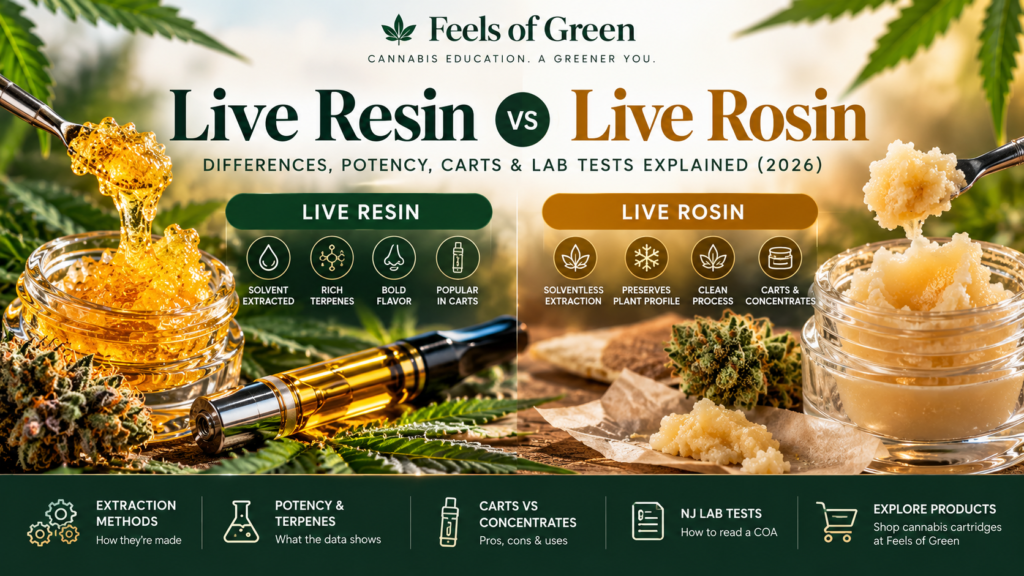
Live resin vs live rosin comes down to extraction—not a guaranteed difference in strength. Here is how the two compare on THC labels, vape cartridges, cost and New Jersey lab testing.
Quick answer: live resin vs live rosin Both usually begin with fresh-frozen cannabis. Live resin is typically extracted using hydrocarbon solvents such as butane or propane, followed by solvent removal and testing. Live rosin is generally made by separating trichomes with ice water and pressing the resulting hash with heat and pressure, without hydrocarbon solvents. Neither category is automatically stronger, safer, or more flavorful. The product and its test results matter. [1] [2]
Which is stronger? Neither category is automatically stronger. Compare the specific batch’s reported total THC, delta-9 THC or THCA using the same analyte and unit. Concentration is not the same as an individual’s response.
Starting material: generally fresh-frozen cannabis.
Defining process: solvent extraction, often using hydrocarbons, followed by recovery and testing.
Common formats: jars, sauce, badder and vape oils.
Starting material: generally fresh-frozen cannabis.
Defining process: trichome separation and mechanical pressing, without hydrocarbon extraction solvent.
Common formats: hash rosin jars and formulated vape oils.
Live resin vs rosin: the differences at a glance
The biggest difference between live resin and live rosin is the extraction process. Both typically start with fresh-frozen cannabis, but live resin generally uses a solvent-based extraction process, while live rosin uses mechanical separation and pressing. Neither name establishes a particular THC percentage, terpene level or health advantage. The table below separates what the names tell you from what the product's own label and laboratory report must establish.
| What to compare | Live resin | Live rosin |
|---|---|---|
| Typical starting material | Fresh-frozen cannabis | Fresh-frozen cannabis, commonly converted to ice-water hash |
| Extraction route | Solvent-based; generally hydrocarbons | Mechanical separation and pressing; solventless |
| Residual-solvent question | Review the relevant laboratory testing | No extraction hydrocarbon is used; other contaminant tests still matter |
| THC concentration | Varies by product, batch and measurement | Varies by product, batch and measurement |
| Aroma / terpenes | Can preserve aromatic compounds; exact profile depends on process and product | Can preserve aromatic compounds; not guaranteed to contain more than resin |
| Retail price | Often less expensive, but not always | Often premium-priced, but verify current price per unit |
| Cart or jar | Available in both, depending on retailer | Available in both, depending on retailer |
| Best way to verify claims | Actual label, manufacturer details and batch COA | Actual label, manufacturer details and batch COA |
Resin: solvent-based, usually hydrocarbons.
Rosin: solventless mechanical process.
Both: THC content varies by product and batch; neither has a guaranteed advantage.
Both: can be aromatic. A label does not prove which one has more terpenes.
Resin: often less costly. Rosin: often more costly. Compare actual prices per gram.
Both: review the exact batch COA. “Solventless” does not mean risk-free.
Both: may appear as concentrates in jars or formulated vape cartridges.
The critical distinction: “Live” usually describes the condition of the cannabis before processing. “Resin” versus “rosin” describes the extraction method. These words are not independent measurements of THC, purity, effect, or safety.
Resin vs rosin vs live resin vs live rosin: what do the labels mean?
A broad word for cannabis plant resin and for extracts marketed as resin. On a finished-product menu, verify the manufacturer's exact process and whether the material was fresh-frozen or cured.
A concentrate produced by pressing flower or hash using heat and pressure, without a hydrocarbon extraction solvent. Rosin alone does not mean fresh-frozen.
Usually a solvent-extracted concentrate made from fresh-frozen cannabis. The final formula and testing still depend on the product.
Usually solventless hash rosin made from fresh-frozen cannabis. Its THC concentration and contaminant results still require product-specific verification.
These are common industry label meanings, not a substitute for manufacturer specifications or a batch COA.
In concentrate terminology, “live” commonly means that cannabis was frozen soon after harvest rather than first being conventionally dried and cured. Drying, curing, freezing, extraction and later storage can each influence the eventual volatile-compound profile. That is why fresh-frozen material is often discussed in connection with aroma. It does not guarantee that a finished cartridge tastes better, contains a particular terpene level, or delivers a specific effect. [2] [3]
Not all rosin is live rosin. Rosin made by pressing dried and cured flower is different from live hash rosin made from fresh-frozen starting material. Likewise, cured resin and live resin need not begin with the same material. If packaging says only “rosin,” check whether the manufacturer identifies it as live hash rosin, flower rosin, or another formulation.
Both routes: typically begin with fresh-frozen cannabis.
Live resin: solvent-based extraction, followed by solvent removal and product testing.
Live rosin: trichome separation and mechanical pressing without hydrocarbon extraction solvents.
Neither route: guarantees a particular THC percentage, flavor or safety outcome.
What is live resin?
Live resin is an extract that typically starts with fresh-frozen plant material and uses a controlled solvent-based process to separate desired constituents. Producers then remove the extraction solvent and prepare the product for the intended format. The precise formulation can change between a concentrate jar and a cartridge. Finished products need appropriate laboratory verification under the rules governing where they are sold.
Because hydrocarbon extraction can produce distinct mixtures of cannabinoids, aroma compounds and co-extracted waxes depending on process conditions, the extraction label alone says little about the finished composition. A 2026 ACS Omega study of two cannabis varieties found that the temperature used during butane extraction influenced the carryover of certain wax-derived alkanes, while total cannabinoids and measured aromatic compounds changed comparatively little over the tested temperature range. That is processing research—not evidence that one retail brand is safer or stronger. [3]
What is live rosin?
Live rosin typically starts with fresh-frozen plant material whose trichomes are mechanically separated, often as ice-water hash. That material is then pressed to produce a concentrate. The process does not require the hydrocarbon extraction solvent used in conventional live resin manufacture. This is the meaningful basis for the term solventless.
Solventless is a description of the extraction approach, not proof that the final product contains no impurities of any kind. Starting materials, processing, packaging, handling and storage all matter. Check the actual batch test and product identity.
Potency, terpenes, flavor and safety: what research actually supports
It is common to hear that rosin is “purer” or that resin is “stronger.” Neither claim follows from the extraction label alone. They can differ in cannabinoid content, volatile compounds, formulation, age, storage conditions, packaging and batch handling. A 2025 scientific review of cannabinoid extraction found that no single extraction technique is universally optimal. [2]
Is live rosin stronger than live resin?
No, live rosin is not inherently stronger than live resin, and the reverse is not guaranteed either. Both are concentrates, but extraction labels cannot tell you the THC concentration of a particular batch. If a live resin cartridge and a live rosin cartridge list different potency figures, first check that the values describe the same cannabinoid measurement, the same unit and comparable product formats. “Total THC,” “delta-9 THC,” and “THCA” are not interchangeable labels. For a closer explanation of these terms and reported test measurements, read our THCA vs THC guide.
Example of label arithmetic, not a product test: 70% total THC by mass is approximately 700 mg of reported total THC per gram of product, on the same measurement basis. This does not tell you how much THC will be absorbed, what effect someone will experience or how much they should use. If another label says 70% THCA, you cannot treat it as the same measurement without understanding the test definition.
There is no single verified THC percentage that applies to all live rosin products. Batch-specific laboratory results are more meaningful than universal numbers found in product descriptions.
High-THC concentrates can produce substantial impairment and carry health risks. The CDC cautions that cannabis concentrates used for vaping or dabbing can deliver very high THC concentrations, and evidence is insufficient to declare one consumption route categorically safe. [4]
Does live rosin always have more terpenes?
No universal comparison is established by the product name. Terpenes and other volatile compounds contribute to aroma, but preservation depends on the material and steps used. Two batches can differ markedly even when both are marketed as “live.” An actual terpene result, if available, is more informative than a marketing adjective. Such measurements also do not reliably predict an individual's physiological response. If you are comparing strain-category language too, our indica vs sativa vs hybrid guide explains why those retail labels are not dependable predictors of effects.
The 2026 hydrocarbon-extraction study shows why sweeping claims are risky: processing temperature changed some wax-related compounds, while the measured volatile fraction was comparatively stable in that particular experimental setup. It did not compare matched commercial live resin and live rosin products. [3]
Is solventless live rosin safer?
“Solventless” means the extract is not made using hydrocarbon extraction solvents. That removes one process-specific consideration, but it does not automatically establish superior safety. Both types may present risks related to high THC concentration, inhalation, contaminants or additives. Do not treat a “PASS” result on one test as proof that every potential health risk has been eliminated. Refer to the actual batch report and the CDC's health guidance. [4] [5]
What not to infer: A higher THC percentage does not establish a better product. A higher terpene percentage does not prove stronger effects. “Live,” “full spectrum,” “premium,” and “solventless” are not substitutes for batch-specific evidence.
Why does live rosin often cost more?
Live rosin is commonly positioned at a higher retail price because its mechanical separation and pressing workflow can require substantial handling and may offer different yields at scale. But price is also influenced by producer, packaging, product size, local taxes and retailer pricing. There is no defensible universal 2026 New Jersey price per gram without checking current, comparable listings. Compare matched product quantities and the actual menu on the day you browse.
Live resin carts vs live rosin carts: compare the right details
Cartridges change the question. A jar of concentrate and a vape cartridge are not the same finished product, even when both use live resin or live rosin as starting material. A cartridge has a specific formulation and hardware requirements. Manufacturer instructions and compatibility matter more than trying to infer performance from the words “resin” or “rosin.” [6]
Identify the format
Is the item a vape cartridge, a disposable vape or concentrate in a jar? Check net content and ingredients first.
Read the formula
Confirm whether the manufacturer calls it live resin, live rosin or a blend. Do not assume a branded name describes the whole formulation.
Verify the batch
Match the product, producer and lot to the relevant report; review listed cannabinoids and applicable contaminant results.
Weedmaps' cartridge-focused guide discusses differences in formulation, viscosity, hardware, storage and price. That is useful context, although the best choice still depends on the individual product rather than an extraction-category winner. [6]
Storage and handling are part of quality
Concentrates and carts can be sensitive to heat, light and repeated exposure to air. Follow the product manufacturer's storage instructions and keep items securely out of reach of children and pets. Do not assume that refrigeration is appropriate for every formulation or device; rapid changes in temperature may create condensation or affect product handling. Stop using damaged or leaking hardware and consult the retailer or manufacturer about a product fault.
Real menu listings: compare live resin and live rosin without guessing
Public Feels of Green listings on Leafly have included the two cartridges below. We reviewed the archived public menu results on November 21, 2026; the listings were captured earlier, and are not a live stock check or verified batch COAs. Their names, net amounts, listed THC figures and prices are illustrations of what a menu may show—not independent laboratory measurements. [11]
Listed format: 1g cartridge. Listed THC: 81.4%. Listed price: $60 for 1g.
Price per gram from that listing: $60 ÷ 1g = $60/g.
Listed format: 0.5g cartridge. Listed THC: 77.83%. Listed price: $52.50 for 0.5g.
Price per gram from that listing: $52.50 ÷ 0.5g = $105/g.
What this comparison actually tells you: on those public menu snapshots, the rosin cart cost more per gram even though its listed package price was lower. Neither the THC figures nor the pricing proves the actual composition, safety, aroma or effect of either batch. The listings could have changed since capture; we did not obtain matching Certificates of Analysis.
Before drawing a potency conclusion: ask whether both THC figures refer to the same analyte and testing method; match each package to its actual lot and COA. Check device compatibility and ingredients, too. A menu can establish advertised information, while a batch report provides specific tested results.
Historical examples only, not endorsements, current prices, current availability or independent testing. For actual selections and batch reports, confirm directly with Feels of Green. For adults 21+.
New Jersey COA guide: what can you verify before choosing a product?
A Certificate of Analysis (COA) is a laboratory report tied to a tested cannabis product or batch. New Jersey's Cannabis Regulatory Commission says consumers can request the COA for products carried by licensed dispensaries. The state's consumer explainer identifies product and sample information, cannabinoid results, optional terpene information, contaminant testing, and other relevant fields. [5]
Do not rely on a screenshot of a percentage alone. Start by confirming that the product's name and lot or batch on the packaging match the report. Then identify the laboratory and reported sample or testing date. A report for a different product or earlier batch should not be treated as the report for the item in front of you.
Current New Jersey testing context: The NJ-CRC says its February 2025 testing guidance was rescinded and the state returned to prior interim standards tied to the Maryland Technical Authority for Cannabis Testing, Revision 3.0. This article therefore does not copy solvent thresholds from the rescinded document. The current NJ-CRC COA explainer and licensed laboratory directory are the appropriate places to check what a report represents. A listed PASS applies to the relevant test—not a guarantee of zero risk. [5] [7]
Our four-point label comparison method
- 1. Match like with like
- Compare similar formats and the same analyte or measurement units; don't compare a jar's THC percentage to a cartridge's package size.
- 2. Confirm product identity
- Match producer, format, lot or batch and testing date. Missing information is a reason to ask questions, not evidence of a failed test.
- 3. Separate measured from claimed
- The extraction process is a manufacturer description; the COA provides measured values for the particular submitted sample.
- 4. Preserve uncertainty
- A small number of reports cannot establish that resin or rosin is always better, and a test report never guarantees risk-free use.
Interactive COA label reader: understand the information, not a sales score
This educational tool explains common labels and the units in which cannabinoid concentration may be reported. It does not check a live laboratory database, validate a batch, recommend doses or predict how a product will affect you. No information entered here is transmitted or stored by this snippet.
Interpret a cannabis label
Ready to interpret: Select the details you see, then choose “Explain this label.” You can leave the concentration empty.
For any real product, request its COA and match the batch number. This guide cannot certify safety.
Why the unit matters
On a mass basis, a concentration of 1% by mass equals approximately 10 mg per gram of the product. That mathematical conversion only applies if the two numbers refer to the same substance, same sample and compatible mass basis. It is not a recommended amount to use, an estimate of absorbed THC, or a reliable way to compare unlike product formats. If a label supplies package milligrams instead of concentration, do not convert it as though it were mg/g.
Original comparison framework: questions to ask of two real products
A useful head-to-head comparison starts with matching product records, rather than claims such as “rosin always wins.” The framework below shows which details to check before drawing conclusions. It is educational: no verified paired Feels of Green batch reports are presented here, and it does not describe current inventory.
On a narrow screen, scroll the framework table horizontally to see each column.
| Question | Product A: live resin | Product B: live rosin |
|---|---|---|
| Identical product type? | Verify jar/cart and net amount | Verify jar/cart and net amount |
| Matching producer and lot? | Record what package and COA say | Record what package and COA say |
| Same cannabinoid field? | Record analyte, value and unit | Record analyte, value and unit |
| Any available terpene panel? | Record reported analytes; don't infer effects | Record reported analytes; don't infer effects |
| Applicable contaminants tested? | Review listed results and test dates | Review listed results and test dates |
| Price normalized to quantity? | Check date and unit | Check date and unit |
| What can be concluded? | Only the verified details above | Only the verified details above |
How to handle a comparison that is missing information: If one menu shows THC% and another gives total package milligrams, do not compare them as though the units match. If a COA is for the wrong lot, request the right one. If two carts have different net amounts, normalize the advertised price per gram before comparing price. If no applicable contaminant panel is shown, ask what testing was done rather than interpreting the absence as PASS. These checks can prevent a misleading conclusion, even when both products use the word “live.”
Understanding concentrates at Feels of Green in Newton, NJ
Feels of Green serves Newton and the wider Sussex County area at 474 US-206, Newton, NJ 07860. Adults seeking regulated cannabis information can browse the cartridge catalog or check store information and promotions while comparing actual product labels with this guide. Because stock and batch details change, this article does not represent a promise that any particular live resin or live rosin product is currently available. [8]
New Jersey permits adult-use cannabis purchases at licensed dispensaries for people 21 and older. Cannabis must not be transported across state lines, including into Pennsylvania, even if someone purchased it legally in New Jersey. Shop only through lawful New Jersey channels, and follow applicable identification, purchase and possession rules. [9] [10]
Compare products using what you learned
Browse Feels of Green's cartridge catalog or check public menu listings to identify the format and named product. Then confirm the actual batch label and COA before relying on reported cannabinoid figures.
Adults 21+ only. Listings, prices and batches can change. Product links are not a guarantee of stock, safety, delivery or interstate shipping.Frequently asked questions about live resin and rosin
Does live rosin contain THC, and what percentage is typical?
Yes. Live rosin can contain THC and THCA, but no single percentage applies to every product. Check the batch COA for which cannabinoid is measured, the unit used and whether the report matches the product. A percentage does not predict individual effects.
Which is stronger, live resin or live rosin?
Neither is universally stronger. Strength depends on the particular product's cannabinoids, concentration and use context. Review matching analyte measurements and remember that a percentage does not predict a person's experience.
Is live rosin always safer because it is solventless?
No. Solventless identifies an extraction approach, not an overall safety rating. Both types can contain high THC levels and can have health risks. Review actual batch testing and public-health guidance.
What is the difference between rosin and live rosin?
Rosin is a solventless pressed concentrate. Live rosin generally refers to hash rosin made with fresh-frozen starting material. Flower rosin made from dried and cured flower is not necessarily “live.”
What is the difference between live resin and distillate?
Live resin is generally a solvent-extracted concentrate made from fresh-frozen cannabis. Distillate is a refined product created through additional separation processes, often intended to concentrate selected cannabinoids. Check formulations because finished products may contain multiple ingredients.
Are live resin carts different from live rosin carts?
They can differ in their source extract and final formulation. Cartridge hardware and compatibility are additional variables. Neither label by itself establishes viscosity, shelf life, potency or safety.
Can a COA tell me whether the product will feel relaxing or energizing?
No. A COA provides tested measurements and other lab information, not a reliable prediction of an individual's subjective effects. Avoid interpreting terpene names or THC percentage as a personalized effect guarantee.
Where can I find a New Jersey cannabis Certificate of Analysis?
The NJ-CRC says dispensaries must provide COAs for products they carry. Ask the retailer for the specific lot or batch report or check an available package QR code. See the official NJ-CRC guide.
Can I buy cannabis in New Jersey and take it to Pennsylvania?
No. The NJ-CRC says transporting cannabis across state lines is illegal, regardless of whether it was legally purchased at a New Jersey dispensary. Adult-use sales in New Jersey are for adults 21 and older.
Research methods and source notes
This guide synthesizes public-health information, peer-reviewed extraction research and New Jersey's official COA guidance. We distinguish measured laboratory findings from retail descriptions and consumer opinions. The 2026 ACS Omega study specifically investigated butane extraction temperatures in two varieties; it is not a controlled consumer trial comparing commercial resin and rosin. The 2025 literature review addresses broader extraction techniques and does not establish a universal retail-product winner. [2] [3]
The archived menu examples are identified as listings, not independently tested products. We did not obtain matched batch COAs, confirm current inventory or prices, or conduct firsthand product testing. A real two-batch laboratory comparison requires those missing records before any claim about measured potency, terpene content or contaminants.
Sources and further reading
- Weedmaps — Live rosin carts vs live resin carts. Product-format and extraction terminology; industry explainer, not laboratory evidence.
- Extraction and analysis of cannabinoids: A decade of progress, challenges and future directions. Peer-reviewed literature review, 2025.
- Temperature Control Minimizes Wax-Derived Alkane Carryover in Hydrocarbon Cannabis Extraction. ACS Omega, published online June 25, 2026.
- CDC — Cannabis frequently asked questions. Public-health information on impairment, concentrate and consumption risks.
- NJ-CRC — Cannabis testing guidelines and how to read a Certificate of Analysis. Updated May 2, 2025 with rescission clarification.
- Weedmaps — Cartridge-focused comparison. Consumer context on carts, formulation and storage.
- NJ-CRC — Licensed cannabis testing laboratories. Official laboratory directory and testing scope.
- Feels of Green — Official online menu and Newton location. Business information only; availability changes.
- NJ-CRC — General information on legal cannabis in New Jersey. Adult-use eligibility and licensed purchases.
- NJ-CRC — Consumer rules and interstate transport reminder.
- Feels of Green Dispensary — public Leafly menu. Publicly available archived Feels of Green menu snapshots reviewed November 21, 2026; original captures predate the review. Two published cartridge labels and their listed sizes, prices and percentages were used for a transparent arithmetic illustration. Not live inventory, current pricing or independently verified COAs.
Educational content for adults 21+. Cannabis concentrates can be intoxicating and carry health risks. This article does not diagnose, treat or recommend cannabis for any medical condition. The publishing website should supply its real author, accurate publication date and applicable editorial-review information; these are not fabricated in the snippet.