
What actually matters in the comparison?
A clear guide to onset, duration, formulation, product labels and New Jersey testing—with evidence and limitations explained plainly.
Research and legal-source check: November 13, 2026 · Adults 21+THC drinks and THC gummies are both orally consumed cannabis products. Some beverages use emulsified formulations that may reach peak blood THC sooner than conventional oil-based edibles, but fast-acting gummies also exist. A quicker blood concentration peak does not guarantee earlier felt effects or a shorter period of impairment. Check the specific formulation, THC per serving, servings per package and testing information before comparing products. [1][2]
THC Drinks vs Gummies: Side-by-Side Comparison
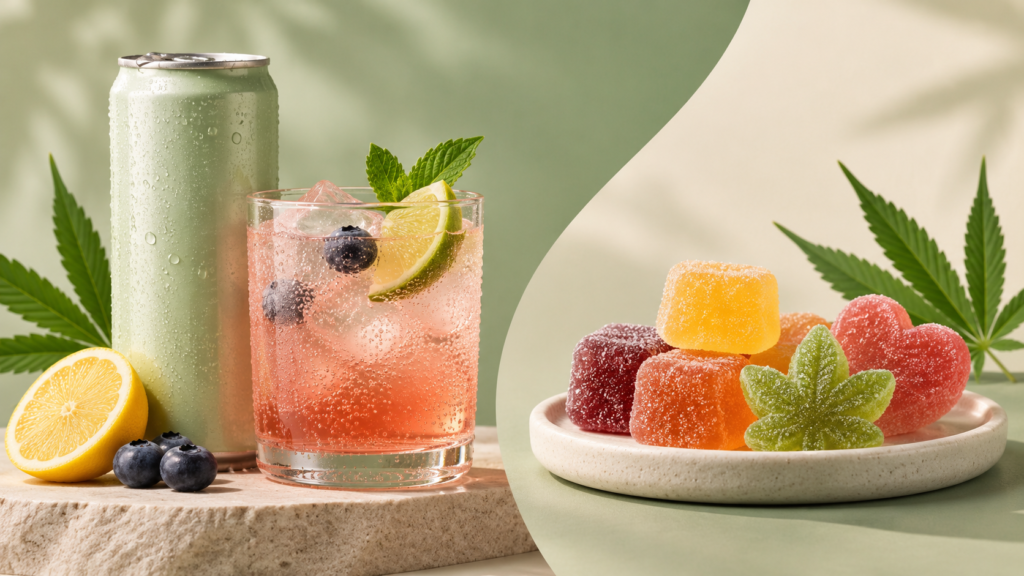
For a useful comparison, begin with what you can actually observe. A drink is a liquid that may be consumed from a can, bottle or mixed powder. A gummy is a solid, individually shaped edible. Neither physical format determines whether the product uses a conventional oil-based formulation or a rapidly dispersing one. Cannabinoid amounts and ingredients also vary within each category.
| Comparison factor | THC drinks | THC gummies |
|---|---|---|
| Format | Ready-to-drink seltzers, sodas, tonics or mixes | Chewable pieces sold singly or in packs |
| Serving information | Check mg per serving and servings per container; one can is not automatically one serving | Check mg per piece, number of pieces and total THC per package |
| Formulation | Some use emulsification; others may not specify it | Can be conventional or formulated as fast-acting |
| Onset | Variable; some formulations show faster absorption | Variable; fast-acting gummies are an important exception |
| Duration | Can remain impairing for hours; no universal clock | Can remain impairing for hours; no universal clock |
| Ingredients | Water, flavorings, sugars or sweeteners may vary | Gel-forming agents, sweeteners, flavorings may vary |
| Storage | Follow beverage refrigeration and opened-container instructions | Follow heat, humidity and original-package instructions |
| Best basis for comparison | Actual label and batch report | Actual label and batch report |
Notice what the table does not say: it never assigns a universal onset time, predicts someone's experience or treats one format as inherently safer. Those claims would overstate the evidence. An adult comparing these products is better served by understanding the printed facts and their limitations.
Looking at edible products in Newton?
Explore Feels of Green's existing gummy information, or open the store's menu page for current shopping navigation. Exact beverage availability is not guaranteed by this guide.
What Counts as a THC Drink—and What Counts as a Gummy?
THC beverages can be seltzers, sodas, tonics, shots or mixes. Some drinks contain more than one serving, so the cannabinoid amount printed on the front may not describe the entire container. Read the serving panel before comparing products.
THC gummies are chewable edibles, often packaged as individually shaped pieces. The THC amount per piece, number of pieces and whole-package total vary by product. Gummies may also list CBD or other cannabinoids.
A label could identify multiple servings inside one bottle. The total cannabinoid amount should be understood separately from the per-serving amount.
Knowing the amount for one piece does not tell you the package total unless you also know how many pieces the package contains.
Both categories are edible cannabis from a public-health perspective: the CDC specifically includes food and drink products when describing edible-related poisoning risks and delayed effects. Advertising that makes a beverage look like ordinary soda can increase the importance of clear storage and labeling. [3]
Do THC Drinks Work Faster Than Gummies?
Sometimes—but the formulation is more informative than the word “drink.” Cannabinoids do not dissolve readily in water. Many beverage manufacturers therefore use emulsions that disperse cannabinoids into a liquid. Similar formulation technology can be used in solid edibles, including gummies. The result is a market where a fast-acting gummy may be more comparable to an emulsified beverage than to a conventional oil-based gummy.
A controlled crossover study published in 2026 evaluated fast-acting, standard and placebo cannabis edibles in 20 participants. The fast-acting edible produced an earlier peak in measured blood THC: the average peak occurred around 30 minutes earlier than for the standard edible. Researchers did not find significant differences between the two active edibles in some other pharmacokinetic measures, including maximum concentration and overall exposure. Importantly, the study compared edible formulations—not a representative sample of drinks against gummies. [1]
That distinction becomes even more important when discussing subjective effects. A separate behavioral report using a comparable study framework found limited evidence that earlier blood absorption reliably translated to earlier measured cognitive impairment. It was a preliminary research report with a small participant group, so it should inform cautious interpretation rather than serve as a universal rule. [2]
How Long Do THC Drink and Gummy Effects Last?
There is no dependable countdown that applies to all edible cannabis products. The amount consumed, formulation, prior cannabis exposure, food intake and individual physiology can all affect when effects begin, peak and resolve. The CDC notes that edibles can take from 30 minutes to two hours to produce intoxicating effects and that those effects can last longer than expected. The CDC's broad guidance covers edibles as a category, not a separate clinical schedule for each commercial beverage. [3]
In August 2026, a randomized trial in JAMA Network Open studied 40 adults who regularly used cannabis. Edible THC impaired aspects of simulated driving performance at testing points two and five hours after exposure. This research was not a head-to-head THC-drink-versus-gummy comparison, but it strongly supports avoiding simplistic “safe after X hours” statements. [5]
Never drive or operate machinery while impaired. Do not use a beverage's advertised onset, a self-reported feeling, or a blood THC number as a personal safe-driving timer. Alcohol and some medications can increase impairment when combined with cannabis. [4] [8]
Feels of Green already has a separate guide to how long edibles take to kick in. This comparison adds the specific formulation and label differences that a general edible-timing article may not cover.
Is the Same Amount of THC in a Drink and a Gummy Equivalent?
Equal labeled milligrams describe equal stated amounts of THC—not necessarily equal absorption or identical experiences. A hypothetical drink labeled 5 mg THC per serving and a hypothetical gummy labeled 5 mg THC per piece both state 5 mg for those respective units. But the ways they were formulated, their other ingredients and each person's responses may differ. We cannot translate matching labels into matching peak blood concentrations or effects.
Another source of confusion is serving versus container. A beverage labeled “5 mg THC per serving” with two listed servings has a labeled total of 10 mg for the entire bottle. Likewise, five gummies at a labeled 2 mg per piece amount to 10 mg per package. These are arithmetic examples, not actual Feels of Green products, not advice on consumption, and not laboratory-tested measurements.
CBD deserves its own line in the comparison. Some products list CBD alongside THC, and a stated 1:1 THC-to-CBD ratio means equal labeled amounts of those cannabinoids within the unit specified by the manufacturer. It does not by itself establish a particular effect or remove THC-related impairment concerns.
How to Read THC Beverage and Gummy Labels
The three most valuable figures are THC per serving, number of servings and THC per entire package. Start by finding out which unit the printed milligram number describes. A front-of-package number might refer to the whole product; the detailed panel may present a serving amount. If they appear inconsistent, do not guess—use the product's documented batch information or ask the licensed retailer to clarify.
| Label field | What to verify | What it cannot prove alone |
|---|---|---|
| THC per serving | How many milligrams the manufacturer attributes to a specified serving | How intensely anyone will feel that serving |
| Servings per package | How many defined servings are in the container or pack | That one can or one package equals one serving |
| THC per package | Whole-pack total and whether it matches the serving arithmetic | Individual absorption and duration |
| CBD / other cannabinoids | Additional cannabinoid amounts and the units used | Guaranteed therapeutic benefit or absence of impairment |
| Ingredients / sugar | Sweeteners, ingredients, nutrition information and allergens if provided | That all drinks or all gummies have a fixed sugar content |
| Batch and COA | Matching lot details, laboratory identification and relevant test sections | A blanket promise that consumption is risk-free |
A Certificate of Analysis (COA) is a laboratory report for a specified product or batch. New Jersey's Cannabis Regulatory Commission explains how to examine cannabinoid results and contaminant testing, and states that dispensaries must provide a COA upon request. The report can help a reader judge whether label and lab information align; it is not a personal medical evaluation. [6]
Interactive THC Drink vs Gummy Label Reader
Use this tool to understand the arithmetic on two hypothetical labels or real labels you have in front of you. It multiplies printed milligrams per serving by the number of servings and, optionally, shows package price comparisons. The calculator does not recommend what to consume, predict effects or verify that a manufacturer's label is accurate.
Compare two package labels
THC per serving and the number of servings are required for each label; prices are optional. Enter positive numbers from the actual label. Leave prices blank if unknown. No sample product data is prefilled.
Want to compare real product information?
Use Feels of Green's published gummy page as a starting point. For beverage options, verify the current store menu directly; this article does not confirm any product's stock or batch results.
What Real Feels of Green Menu Listings Can—and Cannot—Tell Us
For this editorial review, we checked publicly visible third-party listings for Feels of Green in Newton, NJ, on November 13, 2026. They identified beverage examples such as Blur Cherry Glow Seltzer, Cantrip Cola Soda and MyHi Boisterous Berry Stir Stik, each displayed with a 10 mg THC descriptor. A separate public menu also listed gummies including ILLICIT Fruity Cereal 100 mg Gummies (10pk) and Smokiez Sour Watermelon 10pk. These are genuine public-menu observations, not invented products. [10][11]
We deliberately did not compare their prices, onset claims or ingredient quality. We have not verified matching batch COAs, today's in-store availability, the official serving panels or a reproducible equal-size product sample. Any ranking of these products would therefore be speculative. Their role here is simply to show how different physical formats and package descriptions appear in a real local retail context.
What About Sugar, Ingredients, Price and Storage?
Neither category is automatically lower in sugar. Some THC seltzers use little or no added sugar, whereas other beverages are sweetened sodas. Gummies often include sugars or syrups alongside gelling agents, but sugar-free and differently formulated products exist. Read each product's ingredients and available nutrition information instead of making assumptions based on liquid versus solid format.
Price comparisons need the same care. A pack of gummies may contain many labeled servings, whereas a single can may contain one or several. Package price, price per listed serving and price per stated milligram answer different questions. The latter is only a math figure—not a judgment of clinical equivalence, product quality or consumption value. Taxes, discounts and local retail conditions may also affect what appears at checkout.
New Jersey THC Drinks and Gummies: What Shoppers Should Know
New Jersey allows adults aged 21 and older to purchase regulated cannabis from licensed cannabis dispensaries. A consumer should confirm that a particular retailer and product are operating within the applicable licensing framework. The state distinguishes its regulated cannabis marketplace from hemp-derived intoxicating products that may be subject to different laws and transition rules. [7]
On November 12, Governor Mikie Sherrill announced the signing of S-4635/A-5604, a bill aligning state restrictions on hemp products and intoxicating hemp beverages with federal law. Some public interim NJ-CRC guidance still describes the earlier November 13 timetable; do not rely on an older deadline in isolation. This article does not determine whether a particular hemp beverage may legally be sold on a future date. Consult the newly enacted law, NJ-CRC and qualified legal counsel for compliance decisions. [9] [12]
The distinction matters because a hemp-derived beverage in a convenience-store context and a state-regulated cannabis edible at a licensed dispensary may fall under different rules. A national article may overlook that. Feels of Green is in Newton, Sussex County; its website provides shop information and an official menu/navigation page, but a product or flavor should never be described as currently available without checking the live catalog.
Frequently Asked Questions About THC Drinks vs Gummies
Are THC drinks always faster than gummies?
No. Certain emulsified formulations may be absorbed faster than conventional edibles, and fast-acting gummies also exist. Physical format alone cannot establish an individual onset time.
Can a fast-acting edible stop impairing sooner?
It is not safe to assume that. Blood-THC timing and cognitive impairment are distinct outcomes, and the relevant research does not support a universal end time.
Does 5 mg of THC in a drink equal 5 mg in a gummy?
The stated amount is the same cannabinoid mass for the units shown. It does not prove equal absorption, perceived effects or impairment across different formulations and individuals.
Do THC gummies have clearer portions?
Individual pieces may make the printed per-piece quantity easy to identify, but readers must still verify the manufacturer’s serving definition and whole-package total.
Can a THC drink contain multiple servings?
Yes. Never assume a full container is one serving; check the label for serving size, servings per container and total milligrams.
What does “nano” mean on a cannabis product label?
It generally refers to a manufacturer's use of small-droplet or related formulation technology. It is not a certification that an individual will feel effects within a specific number of minutes.
How can I compare THC drinks and gummies fairly?
Record the stated THC per serving, number of servings, whole-package total, CBD content, ingredient list and product or batch information. Use the label tool above for arithmetic only.
Can I request a COA for cannabis edibles in New Jersey?
Yes. NJ-CRC says dispensaries are required to provide a Certificate of Analysis for a cannabis product upon request. Check that the report matches the relevant product and batch.
Do THC drinks and gummies have the same legal status in New Jersey?
Not necessarily. State-regulated cannabis products and intoxicating hemp-derived beverages can fall under different legal provisions. New Jersey enacted a further hemp-law change on November 12, 2026; consult current official rules.
Can I drive when I no longer feel high?
Do not use a subjective feeling or a generalized timing chart to decide you are safe to drive. Cannabis may impair driving skills, and effects can vary for hours.
Bottom Line: Compare the Label, Not Just the Format
THC drinks and gummies both belong to the broader edible cannabis category. Some drinks are formulated for faster absorption, but certain gummies use similar technology. Research also shows that the timing of blood THC measurements is not a reliable shortcut for predicting when somebody will feel impaired or recover. That is why a sound comparison starts with the serving label, the full package total, other cannabinoid information, ingredients and any matching test report.
Continue with verified store information
Read the existing edible-gummies information or open Feels of Green's store menu. Product choice and availability vary; this article makes no stock or effects guarantees.