
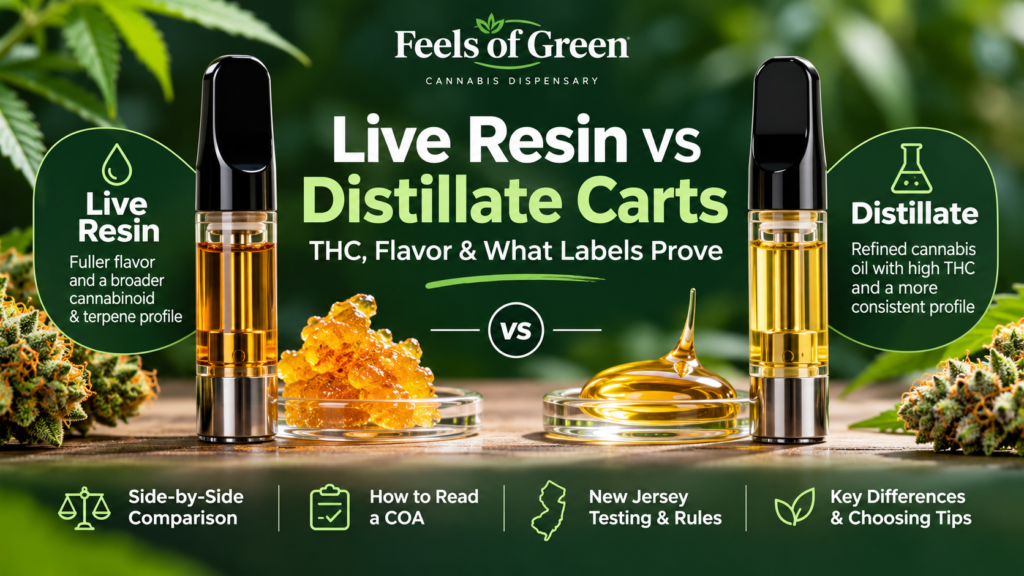
Live resin vs distillate carts—what's the difference? Live resin commonly starts with fresh-frozen cannabis, while distillate undergoes further refinement to concentrate cannabinoids. Finished oils may also contain added terpenes. Neither category guarantees stronger effects, better quality or safety. Compare the manufacturer's formulation, ingredients and batch-matched laboratory results instead.
A research-checked guide for adults 21+ in New Jersey. No particular Feels of Green product, batch, price or stock level is being claimed. Reviewed against publicly available sources November 23, 2026.
Science + label guide · about 13 minutesLive resin vs distillate carts: the key differences
When someone compares these cartridge types, there are really two questions: how was the starting oil produced, and what ended up in the finished cartridge? The first helps explain the product category. The second matters when interpreting cannabinoid measurements, ingredients and laboratory testing. A label that says “live resin” or “distillate” only answers part of the story.
| Question | Live resin cartridge | Distillate cartridge |
|---|---|---|
| Typical starting material | Often freshly harvested cannabis that is frozen promptly | Processed cannabis extract that is subsequently refined |
| Processing goal | Recover a broader set of extractable plant compounds | Concentrate selected cannabinoid fractions |
| Terpenes | May retain plant-derived aromatic compounds | Often formulated with added terpenes |
| Reported THC | Varies by individual product and batch | Varies by refinement and final formulation |
| Flavor claim | Commonly presented as closer to the source cultivar | Can be formulated for a specified aroma profile |
| Appearance | Not a reliable proof of quality or category | Not a reliable proof of quality or category |
| Price | May cost more, but compare actual dated listings | May cost less, but format and brand can change price |
| Best evidence | Manufacturer description plus matching batch documents | Manufacturer description plus matching batch documents |
This table describes common production and labeling practices, not requirements that every cartridge fits neatly. Hybrid formulations exist, and the extract name is not a substitute for verification.
What does “live resin” mean in a vape cartridge?
Live resin is typically associated with cannabis frozen soon after harvest rather than first dried and cured. The material is then extracted, often with hydrocarbon solvents in commercial processing, and further prepared for the intended product. The word live describes the approach to starting material; it does not mean the plant is alive inside the cartridge, or that the resulting oil has not undergone refinement.
Freezing plant material promptly can help retain some volatile aromatic compounds that might otherwise change during drying and storage. But extraction parameters, handling, separation, storage and subsequent cartridge formulation also matter. A genuine live resin product can have a different chemical profile from another genuine live resin product. The extraction category does not guarantee a particular terpene percentage or flavor.
Recent hydrocarbon extraction research illustrates this variability. A 2026 ACS Omega study examined how extraction temperature affected wax-derived compounds carried through into extracts and measured aerosols. Its findings are about processing controls in the tested system—not proof that every live resin cartridge is cleaner or safer than every distillate cartridge. [3]
What is cannabis distillate, and why is it different?
Distillate is an extract that has undergone additional separation to enrich particular compounds, commonly delta-9 THC in regulated cannabis products. Manufacturing typically involves extracting material, preparing it for refinement and using distillation to separate components by their physical properties. This can reduce many of the compounds originally present alongside the cannabinoid fraction.
Because a refined cannabinoid fraction can have relatively little of the original extract's aroma, a manufacturer may formulate the finished oil with terpenes. These might come from cannabis or other botanical sources, depending on the product and applicable rules. A distillate cartridge therefore should not automatically be described as “just THC,” nor should added terpenes be assumed to recreate the source flower's full chemical profile.
Distillate is not synonymous with fake cannabis, and live resin is not automatically unprocessed. Both terms describe manufacturing approaches. Real commercial products may contain more than a single ingredient, so an accurate comparison begins with the manufacturer's formulation statement and the relevant batch documentation.
Live resin path
Distillate path
What's actually in the finished vape cartridge?
Extract type is not the same thing as finished formulation. A live resin cartridge can contain extracted oil that has been processed or adjusted for the device. A distillate cartridge can contain refined THC plus added terpene ingredients. The actual composition depends on the manufacturer's process and the batch, not simply the product title. A listing that doesn't say “live resin” is not proof that the oil is distillate.
We separate the evidence into three levels: manufacturer disclosures can identify the extraction or formulation claim; batch-specific measurements can establish quantities of substances included in the laboratory panel; marketing descriptions such as “premium,” “natural” or “strain-specific” require context before they can be treated as factual chemical comparisons. A standard COA does not necessarily authenticate the exact extraction process used at the factory.
A name doesn't verify an oil
“Live,” “full spectrum” and cultivar-style flavor names do not independently establish the ingredients or the amount of any terpene. Check the maker's technical description and a matching finished-product report.
A COA doesn't verify every claim
A COA may quantify THC or selected contaminants. Unless the method tests for something specific, it cannot prove what every manufacturing step was or predict how a heated aerosol will affect someone.
What about live-resin terpenes added to distillate? The phrase can describe a blended formulation, not necessarily a cartridge filled primarily with live resin. Confirm whether the main oil is distillate, live resin or a disclosed mixture. A terpene claim alone should not determine the extraction category.
Hardware is separate from oil: conventional cartridges require a compatible battery, while disposables include an integrated power source. Either format can use different formulations. For hardware terminology, see our NJ disposable-vape guide.
Which has more THC: live resin or distillate?
Distillation can produce a highly concentrated cannabinoid fraction, but that doesn't guarantee a higher THC number in every finished distillate cartridge. Formulation ingredients change the relative share of each component. Live resin also varies from product to product. Compare measured values on matching finished-product reports, expressed in comparable units, rather than comparing one marketing claim with another.
A percentage and a milligram total are not interchangeable. The percentage describes concentration on the stated reporting basis. Milligrams describe an amount, and interpreting the number requires knowing what mass or serving it refers to. A cartridge with a greater net fill weight can contain a greater total amount of a cannabinoid without having the greater concentration. Neither number establishes the amount delivered per inhalation.
What about THCA and total THC? New Jersey's labeling regulation specifies a calculation for total THC: delta-9 THC plus 0.877 times THCA. The factor reflects the molecular-weight difference associated with decarboxylation; it is not a promise of actual conversion or inhaled dose. For a fuller explanation, see our THCA vs THC label-reading guide. [6]
Be careful with an apples-to-oranges comparison: a total-THC label from one product should not automatically be measured against a delta-9-only laboratory entry from another. Confirm the measurement name, units, sample type and whether it relates to the finished cartridge. That's a better foundation than assuming a particular category always has the highest number.
Terpenes, aroma and the “entourage effect”
Terpenes are aromatic compounds that contribute to the scents of many plants, including cannabis. Different extraction and processing methods can influence which compounds remain in the oil. Manufacturers may also add terpenes during formulation. As a result, “live resin” and “distillate” do not tell you the exact terpene composition of a finished cartridge. A product-specific laboratory profile, where provided, is more informative.
Some sellers attribute predictable relaxing, uplifting or focused effects to particular terpene combinations. Human evidence is not strong enough to promise those specific outcomes from a cartridge's extraction category. The often-discussed “entourage effect” is a hypothesis with ongoing research, not a universal formula linking a terpene name to an individual's experience.
Flavor also isn't a health or safety grade. A 2025 scientific review of cannabis concentrate vaping chemistry discussed how heating cannabinoids and terpenes may produce additional compounds in aerosols. Those findings justify caution about broad claims of purity; they do not prove that one retail cartridge category is universally risk-free. [4]
What does vaping research show—and what does it not show?
Research on cannabis vaping increasingly considers the whole system: the oil's composition, the materials in the device, heating conditions and the aerosol ultimately produced. This matters because laboratory testing of bottled or filled oil is not identical to direct testing of what leaves the device. A certificate of analysis provides valuable product information, but it doesn't characterize every possible inhalation exposure.
| Research | What it investigates | What we cannot conclude |
|---|---|---|
| 2026 hydrocarbon extraction study [3] | Processing temperature, wax-derived compounds and tested aerosol samples | That all live resin carts are safer than all distillate carts |
| 2025 vaping chemistry review [4] | Cannabinoids, terpenes and potential heated degradation products | That terpene richness guarantees a healthier inhaled product |
| 2025 cannabinoid vaping review [5] | Product composition, regulation and emerging toxicology | That a label alone predicts health outcomes for an individual |
These studies do not form a matched clinical trial of live resin versus distillate products sold in Newton, New Jersey. We should say so plainly. Research can strengthen a comparison without pretending that laboratory findings settle an individual safety or effects question.
Safety context: Cannabis vaping is not risk-free. Concentrated THC products may carry greater intoxication and dependence-related risks, and vaping has been associated with lung injury. Avoid informal or unverified products, keep all cannabis out of reach of children and pets, and never drive while impaired. The CDC provides a broader overview of these risks. [8]
What New Jersey cannabis rules tell us about cartridge labels
For licensed New Jersey cannabis products, packaging and laboratory reports offer more useful information than a broad category label. State regulations address required cannabinoid disclosures, relevant ingredient information and warning statements. They also describe permitted ingredients for inhalation or vaporized formulations. For example, the listed regulation limits total terpenes in those products to 10% of the product; that is a formulation rule, not a recommended level or proof of safety. [6] [7]
New Jersey's Cannabis Regulatory Commission says consumers may request a certificate of analysis from a dispensary carrying the product. The guide identifies useful information such as product and batch identity, laboratory results and contaminant panels. A batch report is valuable only when it corresponds to the specific item being discussed. [1]
Which NJ testing guidance applies? The NJ-CRC confirms that its February 2025 special testing guidance was rescinded and the prior interim standards restored, using the Maryland Technical Authority for Cannabis Testing, Revision 3.0 as the reference. Its February 2026 market review separately reports that all eight laboratories examined were cited for not following required testing standards at that review. That regulatory finding is an oversight concern; it is not proof that a particular Feels of Green cartridge failed a test. [2] [9]
How to request a matching report: Note the package's exact product name and lot number, request the relevant COA from the retailer, then compare identifiers and test dates. New Jersey's official guidance says dispensaries must make product COAs available on request. The NJ-CRC also publishes a list of licensed testing laboratories. [1] [10]
Cartridges are a significant New Jersey product category: the regulator's February 2026 review reported vape cartridges at 26.4% of the state's cannabis market, second to flower. That is sales-category context, not evidence of live-resin-versus-distillate search volume or product superiority. [9]
Interactive guide: how to read a cartridge COA
A Certificate of Analysis (COA) is a laboratory report for a tested product or batch. Rather than treating a green “pass” box as the end of the inquiry, start with identity, examine what was actually measured and read the limitations of the reported panel. This guide uses standard field names; it does not display a Feels of Green product COA or claim that we performed testing.
Explore the eight report fields
Open any field below to see what to check on a real report. When scripting is available, the selector can jump to the chosen explanation; the complete glossary remains usable without JavaScript.
1. Product name and batch number
Check whether the report's identity matches the package and the relevant lot. A result from a different batch does not verify the cartridge in front of you.
2. Testing laboratory and dates
Look for the named laboratory, report or sample identifiers, sample type and dates. These establish whose analysis is being shown and when it was performed.
3. Cannabinoid profile and units
Distinguish delta-9 THC from THCA and calculated total THC. Check whether the result is a percentage, mg/g or another unit; do not compare different bases as if they were identical.
4. Measured terpene profile
A reported terpene result describes the compounds measured in that sample. A flavor name or “full spectrum” claim is not equivalent to a laboratory profile.
5. Residual-solvent panel
Check which applicable solvents were tested and the results. The details may differ with product type and testing standards; a single panel doesn't measure every imaginable chemical.
6. Other contaminant panels
Look for the applicable pesticide, heavy-metal, microbial or other categories listed. Identify what was tested rather than assuming every item has identical panels.
7. ND, LOQ and reporting limits
“ND” commonly means not detected under the method's conditions, not necessarily absolute zero. The limit of quantitation describes the concentration reliably quantifiable by that method.
8. Results and pass / fail criteria
Read any threshold or criterion against which a result was judged. A passing result for listed tests does not constitute a blanket guarantee about health outcomes.
Educational field guide based on NJ-CRC consumer guidance, not a diagnosis, safety certification or interpretation of a particular retailer's lab report. [1]
How to compare two actual cartridges fairly
Ideally, compare two products in the same cartridge format, with manufacturer-confirmed extraction categories, equivalent reported units and clearly identified finished-product batches. Note any differences in fill weight, additional ingredients and date of observation. If either product lacks a confirmed extraction category or a matching COA, leave that field unverified. Don't infer missing information from an attractive label.
Use these checks on real products. Each row shows a question you can resolve, the evidence needed and the conclusion you should not draw. This is an editorial verification method, not a dataset of tested Feels of Green cartridges.
| Check | Source to inspect | Supported conclusion—and limitation |
|---|---|---|
| 1. Extraction category | Manufacturer's explicit product or formulation description | Supports a “live resin,” “distillate” or blend classification; the COA alone may not establish the method. |
| 2. Product identity | Label, package and COA product / batch identifiers | Supports a batch-level comparison when identifiers match; a different lot does not verify this item. |
| 3. THC concentration | Finished-product cannabinoid panel and stated units | Enables comparison of like-for-like concentrations; it does not establish dose per inhalation. |
| 4. Terpene claims | Manufacturer ingredients plus any measured terpene panel | Distinguishes added or reported compounds from flavor language; it does not predict effects. |
| 5. Testing status | Relevant contaminant panels, thresholds and dates | Shows results for the listed tests; no limited panel proves the absence of all possible risks. |
| 6. Price / size | Two dated listings with equal quantity units and format | Can support a narrow cost comparison; one listing cannot prove a universal price advantage. |
Example of the reasoning—not a fictional product: If a listing says “live resin terpenes,” but the maker identifies the main oil as distillate, classify it using the verified full formulation, not the flavor phrase. If the posted COA lacks a matching batch number, treat the displayed potency as unverified for that particular package.
No Feels of Green product COAs, comparative retail prices or original batch-test results were supplied. We therefore publish the decision rules rather than inventing measurements, inventory or brand comparisons. A dated first-party comparison can be added once matching documents are available.
Why do prices and cartridge formats differ?
The price of a vape cartridge can reflect extraction and refinement choices, starting material, manufacturer, hardware, package size, testing, distribution and retailer pricing. Live resin is sometimes positioned as a premium extract, but its category label alone doesn't establish a fair price comparison. We wouldn't compare a half-gram specialty cart with a one-gram distillate cart and call the result a pure extraction-price difference.
When genuine listings are available, record the observation date, the stated net mass or volume, and whether an applied promotion changes the price. Price per gram is useful only when products use comparable mass units. Milliliters and grams are not interchangeable without a defensible density conversion. Manufacturer claims about extract type should also be confirmed before assigning a cartridge to either category.
For adults researching local cartridge formats in Sussex County and nearby parts of northern New Jersey, our Feels of Green cannabis cartridges page is the relevant site destination. The live menu should be checked separately for current listings and prices; this article does not certify what's in stock today.
If the question is “Which cart is better?”, start with better for what claim? The two extraction categories describe different ways of making oil; they don't tell you a universal ranking of THC, flavor, value or safety. The most defensible comparison uses a confirmed formulation and matching finished-product measurements—and accepts “not verified” whenever the evidence is absent.
Frequently asked questions
1. Is live resin the same thing as live rosin?
No. Both are often associated with fresh-frozen starting material, but live resin typically involves solvent-based extraction, whereas live rosin uses a solventless mechanical process. Our live resin vs live rosin guide covers that separate comparison.
2. Is distillate always stronger than live resin?
No. Distillate manufacturing can enrich THC, but a finished cart's cannabinoid concentration depends on its actual formulation and laboratory result. Compare equivalent measures from specific batches instead of assuming one category always wins.
3. Does live resin always have more terpenes?
Not necessarily. Its starting-material approach may preserve some aromatic compounds, but extraction, processing and formulation can change the profile. A batch-specific analysis provides stronger evidence than an extract name.
4. Are added terpenes automatically bad?
No universal conclusion follows from their presence alone. The relevant questions are ingredient identity, applicable formulation rules, amounts and the evidence about the finished aerosol. Added terpenes should not be assumed harmless merely because they come from plants.
5. Can color prove that a cartridge contains live resin?
No. Color varies for many reasons, including material and processing. Appearance cannot authenticate an extraction method, laboratory result or the composition of a finished oil.
6. Does a higher THC label guarantee stronger effects?
No. Label concentration is not the same as delivered exposure or individual response. Product formulation, device behavior and personal factors can differ. Higher concentrations also carry risks and should not be treated as a quality score.
7. Where can I see a cannabis cartridge's lab report in New Jersey?
The NJ-CRC says consumers can request the product's certificate of analysis from the dispensary. A package or linked QR code may also provide access. Confirm that the report corresponds to the actual batch.
8. Does a passing COA prove a cart is completely safe?
No. A COA documents the tests, results and criteria that apply to the tested sample. It does not guarantee the absence of every possible risk or predict individual health outcomes from inhaling the aerosol.
9. Are live resin and distillate available as disposables too?
Potentially, yes. The oil formulation and the hardware format are different classifications. Check manufacturer disclosures to identify the oil type, and avoid inferring the contents from the device's shape.
10. How can I compare the price of two carts accurately?
Use dated, genuine listings with comparable stated quantities. Record promotions, device differences and whether the extract category was verified. Don't claim a universal price advantage from one unmatched pair of products.
Research methodology, limitations and references
How this article was assembled. We consulted New Jersey's consumer COA guide and cannabis labeling rules alongside peer-reviewed research on extraction and vaping chemistry. Our tables, processing diagram and six-check label framework are original editorial syntheses of those sources, not new laboratory experiments. No Feels of Green cartridge underwent independent testing for this article; no retailer batch COA, dated price comparison, product availability record, clinician review or named author credential was provided. A real WordPress author attribution and dates should be added only after editorial verification.
Regulations and research may change. We distinguish laboratory findings from universal claims about finished products. This article is educational and does not provide personalized medical or legal advice.
- New Jersey Cannabis Regulatory Commission. How to Read a Certificate of Analysis for Your Cannabis Product. Official consumer guide.
- NJ-CRC. Cannabis Testing Guidelines and How to Read a Certificate of Analysis. Confirmed rescission of the February 2025 guidance and return to interim standards.
- Sosa ME and colleagues (2026), ACS Omega. Temperature Control Minimizes Wax-Derived Alkane Carryover in Hydrocarbon Cannabis Extraction. Processing-specific experimental findings.
- Munger KR, Anreise KM and Strongin RM (2025), Frontiers in Toxicology. Cannabis concentrate vaping chemistry. Scientific review.
- 2025 Chemical Research in Toxicology. Cannabinoid Vaping Products: Regulation, Composition, Toxicological Effects, and Emerging Research. Review.
- New Jersey Administrative Code, N.J.A.C. 17:30-16.3: Cannabis item labeling requirements.
- New Jersey Administrative Code, N.J.A.C. 17:30-11.6: Ingredients in cannabis products.
- U.S. Centers for Disease Control and Prevention. Cannabis Frequently Asked Questions; risks associated with concentrated extracts and vaping.
- New Jersey Cannabis Regulatory Commission. 2025 in Review, published February 2026; statewide vape category figures.
- New Jersey Cannabis Regulatory Commission. Licensed Testing Laboratories, current NJ-CRC reference directory.
For neighboring topics, read our live resin vs rosin guide and THCA vs THC explanation. Current products and prices must be checked independently on the Feels of Green menu.